Half of 2026 is gone, and the Lagos property market has confirmed the central thesis of our December report: the money is being made at the edges, not the centre. Emerging corridors on the Lekki-Epe axis are appreciating at nearly three times the rate of Ikoyi and Victoria Island, the shortlet economy has crossed ₦264 billion in annual revenue, and a government-backed mortgage fund is lending at 9.75%, the first single-digit rate most working Nigerians have ever been offered. This is CBC Africa's half-year review of where prices, yields, and risk actually stand, drawn from our advisory work and The Lagos Real Estate Outlook 2026.
What Does It Cost to Buy in Lagos Right Now?
Start with the raw numbers. These are representative mid-2026 asking prices for standard stock in each market, from our transaction and listing data:
- Ikoyi: 3-bedroom luxury apartment, ₦850 million
- Victoria Island: 4-bedroom terrace/apartment, ₦600 million
- Lekki Phase 1: 4-bedroom terrace, ₦350 million
- Ajah: 4-bedroom terrace, ₦160 million
- Yaba: 2-bedroom apartment, ₦140 million
- Ibeju-Lekki: 4-bedroom detached, ₦80 million
The spread tells the story: the same money that buys one luxury apartment in Ikoyi buys ten houses in Ibeju-Lekki. That gap is not a mispricing. Ikoyi buys scarcity, infrastructure, and prestige. But it frames the real question for investors: which end of that spread is growing faster? The answer is unambiguous. In 2025, land along the Ibeju-Lekki and Epe axis appreciated around 17.5%, the broader Lekki and Ajah corridors did 12.5%, Yaba managed 9%, while prime Victoria Island and Ikoyi returned roughly 6.5%. Prime Lagos preserves wealth; emerging Lagos multiplies it. Over five years the compounding is dramatic. Parts of the prime market have still recorded 38 to 60% cumulative price growth, but Ibeju-Lekki has delivered over 300% in a decade.
Ibeju-Lekki & Epe Land Appreciation, 2025
Lagos Shortlet Revenue, 2024
MREIF Mortgage Rate: First Single-Digit in a Generation
Land Appreciation by Area, Annual Rate 2025 (%)
The Lagos Real Estate Outlook 2026, CBC Research
Emerging corridors continue to outperform prime areas by nearly 3x
What Is Actually Driving This Market?
Appreciation numbers mean nothing without drivers, and Lagos's drivers in 2026 are unusually concrete. The Dangote Refinery is operating and hiring across the Ibeju-Lekki corridor. The Lekki Deep Sea Port is moving cargo and pulling logistics businesses east. The Lekki Free Trade Zone keeps signing industrial tenants, the Green Line rail and the Lagos-Calabar Coastal Highway are re-drawing commute maps, and behind all of it sits the demographic engine: Lagos absorbs roughly 6,000 new residents every day against a housing deficit of 3.4 million units.
Then there is the money from abroad. Nigeria received an estimated $23 billion in diaspora remittances in 2025, and an increasing share of it is buying property rather than funding consumption. We estimate around 70% of luxury transactions now involve a diaspora buyer. Meanwhile construction costs keep rising (cement has more than doubled since 2022), which quietly supports the price of existing stock: every completed building becomes more expensive to replicate.
The supply side is responding, but lopsidedly. The active development pipeline holds about 34,800 residential units, of which 753 are luxury apartments priced above $1 million, concentrated in Ikoyi and Victoria Island. Nigeria's real estate sector is now valued at ₦41.3 trillion (NBS, post-rebasing), making it the country's third-largest sector. Yet the overwhelming majority of new construction targets the top 1% of the market while the deficit sits in affordable and middle-income housing. For investors, that mismatch is the opportunity: the underserved middle is where demand is deepest and competition thinnest.
On the income side, strategy now matters more than location alone. Gross rental yields in 2025 to 2026 range from 18% for prime shortlet operations and 12% for average shortlets, down to 7% for mid-market mainland rentals, 5% for traditional prime leases, and just 3.5% for luxury Island property. The shortlet market has grown 263% since 2022. The pattern is worth stating plainly: the most expensive assets in Lagos produce the lowest income returns. Luxury is a capital-preservation play, not a cash-flow play.
Gross Rental Yield by Strategy, 2025 to 2026 (%)
The Lagos Real Estate Outlook 2026, CBC Research
Shortlet operations out-earn traditional leases, at the cost of higher operating effort
"Prime Lagos preserves wealth. Emerging Lagos multiplies it. The mistake is expecting either one to do the other's job."
How Should Investors Position for H2 2026?
Four moves follow from the data. First, match the asset to the objective. If you need income, the yield table says shortlet or mid-market mainland; if you need appreciation, the corridor data says Ibeju-Lekki, Epe, and the eastern axis; if you need to park wealth safely, prime Island still does that best. Second, take the mortgage window seriously. The MREIF fund's 9.75% rate changes the arithmetic for salary earners and diaspora buyers who have only ever seen 20%+ mortgages. Financing a home while renting out capital-efficient investments is now a viable structure. Third, respect the rent wave. Lagos rents rose over 80% in 2025 in some corridors, with landlords repricing mid-tenancy. For investors this is yield support, but it also means tenant affordability is stretched, so underwrite conservatively. Fourth, verification still decides outcomes. None of the appreciation above accrues to the holder of a defective title. Registry search, charting, gazette confirmation: all before any money moves.
H2 2026 Market Signals (CBC Research Assessment)
Emerging Corridor Momentum88%
Shortlet & Income Demand82%
Mortgage & Financing Access61%
Affordable Supply Response34%
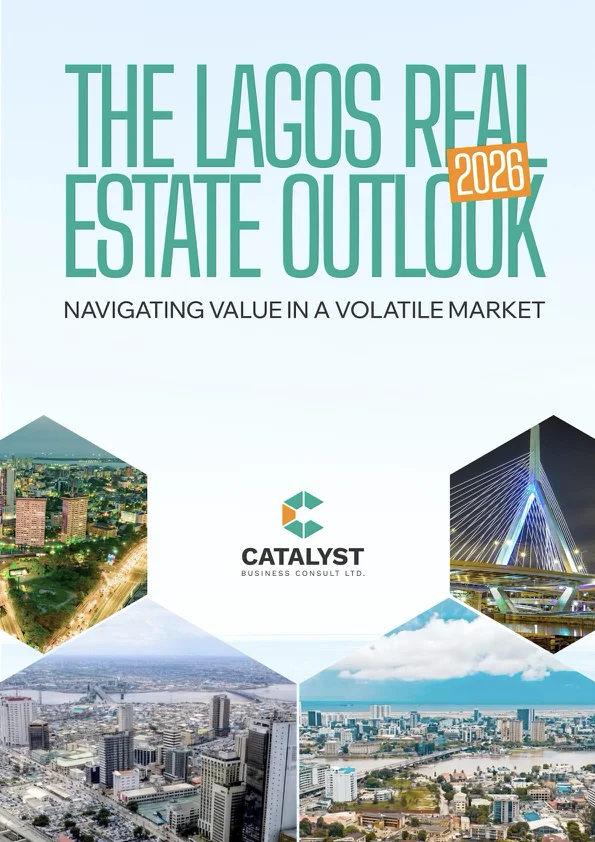
The second half of 2026 will reward investors who act on data rather than noise. The full 58-page report, with corridor-by-corridor analysis, price histories, the title verification toolkit, and complete investment strategy frameworks, is free to download.
Get the Full Market Report
The Lagos Real Estate Outlook 2026 is 58 pages of data, analysis, and insights for investors, homebuyers, and wealth builders. Free from CBC Africa.